

Oregon Makers is an occasional series about creators, makers + artists across Oregon who not only create but contribute to the built environment of Oregon’s cities in creative and impactful ways.
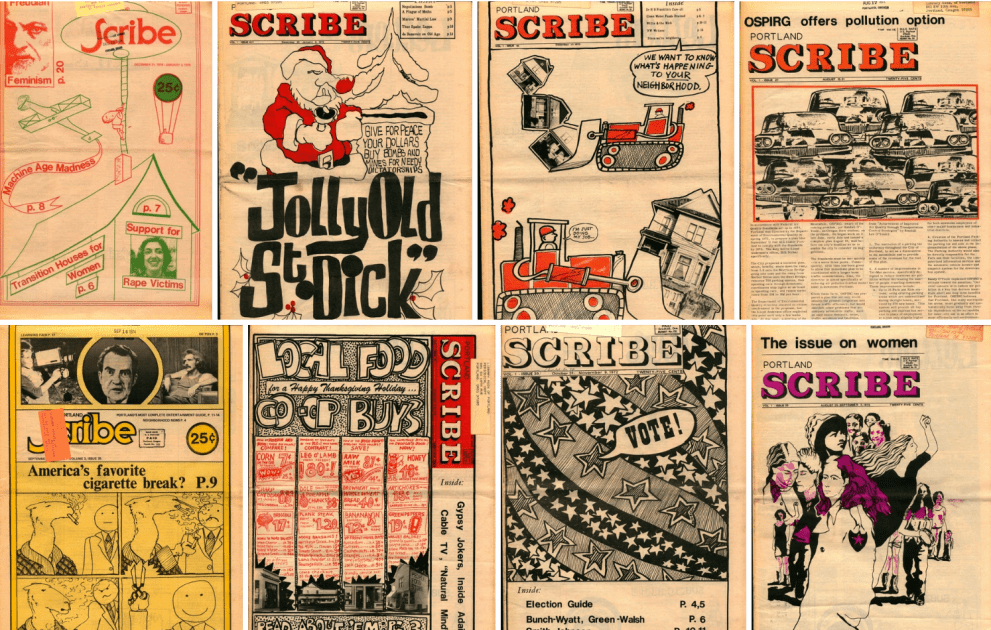
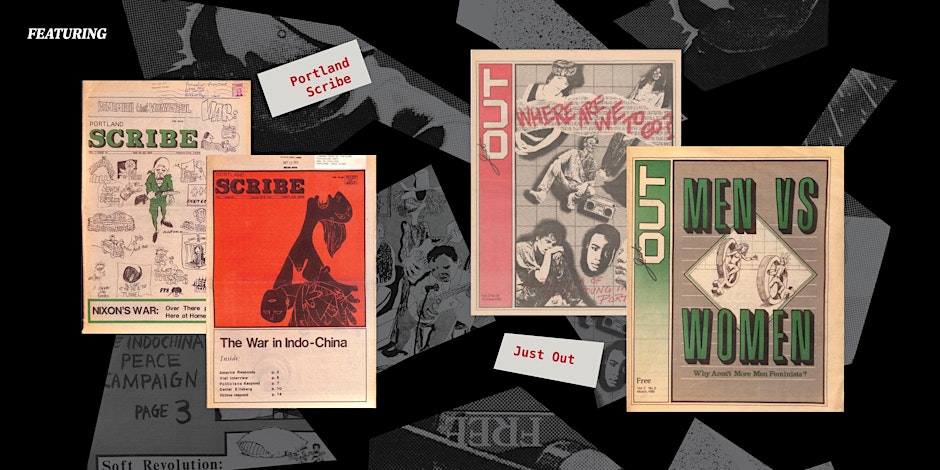
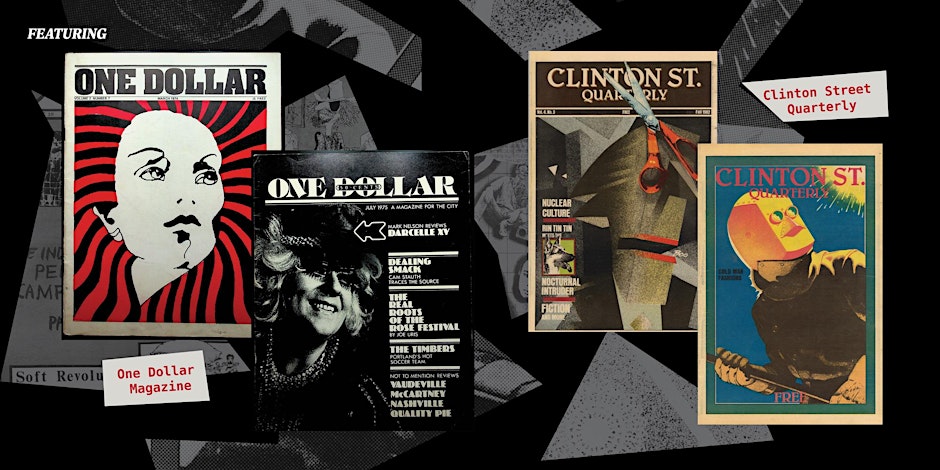
The upcoming Underground Press: Portland’s Counterculture Publications of the 70s & 80s celebrates Portland’s independent publications from the 70s and 80s. The event will dive into the counterculture movement, exploring the design, people, and technologies behind papers like Portland Scribe and One Dollar, and offers a hands-on look at how these publications shaped the city’s creative history.
Melissa Delzio, a designer and founder of the Portland Design History project, is behind the event, continuing her work to uncover and share Portland’s design legacy. I sent over a couple of questions and she graciously answered.
Print’s not dead – start a zine!
Tell me about the event
The event will explore how Portland’s independent publications of the 70s & 80s gave voice to the counterculture. We will look at the design, people, technologies and cultural forces that powered the movement. In the 1970s, scrappy newspapers such as the Portland Scribe were launched as a reaction to the Vietnam War and echoed the counterculture movement from the 1960s, while publications like One Dollar experimented with sleek design and a highlight on the arts. In the 1980s, Just Out united and amplified the LGBTQ+ community and Clinton Street Quarterly proved that independent journalism could be an exquisitely designed work of art! This event will offer a vibrant and visual overview of these publications and feature a physical showcase (a publication fair) of these works for hands-on browsing.
Is your background in design? Tell me how you got here.
My background is in design, I graduated with a degree in Visual Communications and moved to Portland straight after in 2004. I have been a practicing designer since then, and have run my own studio (Meldel) since 2009. I have always been interested in community building, serving on the board of directors for AIGA Portland, and founding a community story project called Our Portland Story which ran from 2008 – 2014. I started the Portland Design History project in 2014 after hearing Byron Ferris speak. From him, I learned about the foundations of modern design in Portland and, with his death, I saw the need for these histories to be recorded and works to be saved.
Tell me about the Portland Design History project.
It’s broadened in scope over the last 10 years, expanding beyond modernism to include many illustrators, and DIY-ers outside of the commercial design realm. Since 2014, I have conducted dozens of interviews, scanned hundreds of pieces of work, dug through dozens of archives, and with PSU students, written 12 biographies or long-form articles about various design topics of interest. I am hoping to build a historical narrative for students and practitioners of design. I seek to show the steps taken to make the profession what it is here, to discover and preserve a visual record of design produced, and to identify and characterize important contributors and themes and to engage students along the way.
Portland isn’t known (or maybe it is?!) as a hotbed of graphic design – did this 70s underground newspaper movement influence design in the 90s and beyond?
I would certainly not say it was a hotbed, but there was a core group of designers postwar who formed the foundation of what the design community is today. Their early work for big brands like Jantzen laid the groundwork for Wieden+ Kennedy’s work with Nike, and established Portland as a sports marketing hub. The people who produced the underground magazines did not overlap much with the commercial designers, so I think of them as separate tracks. The underground magazines gave a huge boost to Portland’s writers like Walt Curtis and Katherine Dunn, artists like Henk Pander and Isaka Shamsud-Din, comic artists like Rupert Kinnard and John Callahan and filmmakers like Jim Blashfield and Bill Plympton. The publications of the 70s and 80s all have strong connections to the music community, from the folk music of the counterculture to the newer reverberations of punk. The publications connected and strengthened all of the arts community. By the 90s many of these main characters were well on their way to broader notoriety.
Is there a connection / bridge with the whole 90s zine movement?
As technology advanced and continued to democratize design, artists could self-publish with nothing but a Xerox machine. Magazines like Plazm carried on the tradition started by Scribe, Clinton St. Quarterly, but also Mississippi Mud. Plazm’s creators said that while their magazine had a much higher production value, at its core it was founded with a zine philosophy. I haven’t studied zines exclusively yet, but am very interested in how they overlap with the punk movement and feminism. What is consistent across the publications is a DIY spirit, a focus on the arts and social justice message.
The Underground Press: Portland’s Counterculture Publications of the 70s & 80s takes place on Thursday, October 24 · 5 – 8pm.
UPDATE: If you missed the event, watch it here:
Discover more from Lost Oregon
Subscribe to get the latest posts sent to your email.
 Lost Oregon
Loving this attention to the Scribe! For those interested in more information, check out https://oregoncartoonproject.org/underground-usa/, my late sister’s, Anne Richardson’s, underground arts-oriented project. The Scribe operated out of Centenary Wilbur, which was my father’s, Reverend Austin Harper Richardson’s, church. I am in the processing of writing about the role of his ministry in 1960s-70s era Portland progressivism. If you’d like to connect, especially if you have information to share because you or your parents were members of the congregation, please reply and we’ll get in touch.